Trump Disclaimer
There is no national security (inter alia) so long as we leave Donald Trump et al in power. I think all analysis and discussion needs to start with that acknowledgment because we can’t act as though the current moment is normal, acceptable, or inconsequential. Things are not normal and Trump et al Regime is daily violating law, constitution, policy, and common human decency. In addition, Trump consistently demonstrates distorted thinking marked by various mixes of motivated thinking, hallucination, lying, or detachment from reality. We must work to remove the Trump Regime from power ASAP.
Goals of this Post
We’re gonna have some morbid bemusement with this one, y’all! In a previous post (here), I discussed a BONKERS memo from a Trump Regime lackey; the Beck Memo established an absolutely unrealistic and impossible (in totality and in most of its details) set of demands. In THIS POST, I have three goals. First, in passing, to partly substantiate my “nope!” reaction to the Beck Memo. Second, to offer suggestive examples from a key site (Los Alamos) of what the USA nuclear weapons complex is like and some of the challenges to accelerating existing programs and adding new ones. Third, to enjoy and invite you to enjoy a sort of bemused and appalled shock at the discordances between what we might imagine about making nuclear weapons and what actually happens in making nuclear weapons.

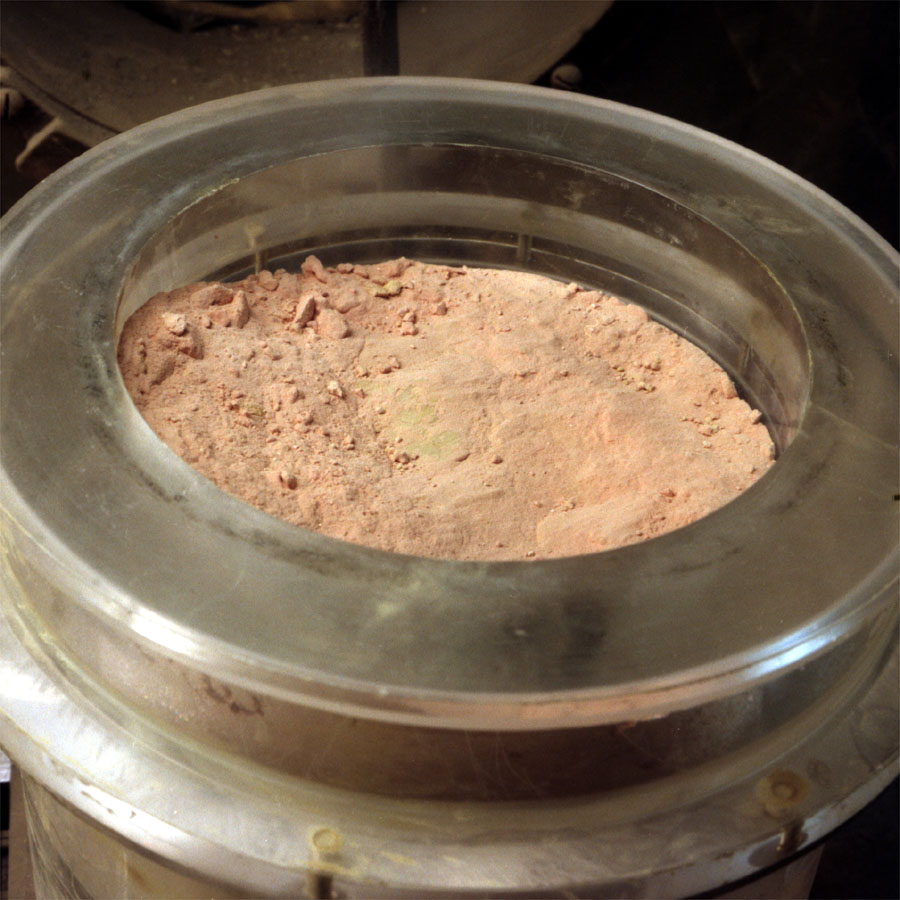
Caption: Plutonium tetrafluoride powder; image released to me by DOE through the Freedom of Information Act (FOI 2019-00371 at Richland DOE office). Plutonium tetrafluoride is an intermediate product in making plutonium metal in a process the USA no longer uses.
Dataset
My proximate sources for most of this post are 2025 & 2026 Defense Nuclear Facility Board reports.
RESULTING BONUS DATASET!
I have made a new single pdf dataset of calendar year 2025 DNFSB Resident Inspector reports on Los Alamos available here: https://osf.io/46sfd/files/5yxru (individual reports are cited below by date as in “2025 Jan 1”). A document with DNFSB RI reports for LANL for January thru May 1 2026 is here and cited the same way.

Caption: A publicity photo from Los Alamos (LANL 2025), it is simply captioned “Facilities engineers gather at the Plutonium Facility.” Please notice that one person is already wearing gloves and everyone has on anti-contamination booties and outerwear & eye protection. This is good, standard PPE .
Recap and Orientation
Currently the USA is in the process of refurbishing and “modernizing” almost the entirety of its nuclear weapons arsenal and nuclear weapons production complex (GAO 2026). Facilities of the so-called “Nuclear Security Enterprise” (NSE) are often old, fragile, incomplete, and under-maintained (Fink 2025) despite the importance of nuclear weapons in widespread (hegemonic even) official and public imaginaries of USA power and security.

Caption: A National Nuclear Security Administration (NNSA) response to a Question for the Record by a Congressperson; in this case, Representative Desjarlais from a 2019 March 8 Senate Armed Service Committee Hearing (h/t to Government Attic for getting it released through the Freedom of Information Act). This blunt answer makes clear that the NNSA nuclear weapons complex lacks redundancy and is subject to numerous potential single-point failures. This has not changed substantially since 2019.
For example, since 1989 the USA has lacked the ability to produce plutonium pits—the nuclear material used in the primary stage of every USA weapon deployed—in substantial numbers (DOE/EIS-0573; Fink 2025). Then Congress, in the Fiscal Year 2015 National Defense Appropriations Act, established a requirement that the Department of Energy (DOE)/National Nuclear Security Administration (NNSA) develop (in a timeline long blown) the capacity to build at least 80 pits per year (Medalia 2015).

Caption: Image of workers presumably in the Los Alamos Plutonium Facility (PF-4) in Technical Area 55. From a (NNSA 2016) factsheet. Document also notes that PF-4 began operations in 1978. The ongoing plan and actions are installing industrial level plutonium processing and pit production equipment in a fifty year old and radiologically filthy building already being used for things. Glovebox gloves, when not in use, are usually tied off on outside of the glovebox, is my understanding.
Status and Challenges
Making plutonium pits at Los Alamos means doing multiple things at once in the same space (which was not designed for this) including construction, equipment removal & installation, and plutonium processing. Triad—the contractor that operates Los Alamos—is moving (or has moved) PF-4 into 24/7 operations (2025 Apr 8; Triad PER 2025, 3, 4, 12). Thus, there are “rooms where a combination of production, construction, and legacy equipment removal activities are occurring” (2025 Sep 12). It’s rebuilding your workspace while still working there. To cut down on conflicts, “[p]roduction operations remain primarily on the day shift, while maintenance, construction, and equipment removal work dominate the nights and weekends” (2026 Jan 2).

Caption: How neat, tidy, and organized plutonium pit production looks in this diagram! Although it is useful as an idealized overview of a “simplified plutonium pit production process” (DOE 2026, DEIS).
Further complicating everything—including imaginaries of nuclear weapons production tasks as sterile, high-science—is that Los Alamos Plutonium Facility-4 is a highly complex and (radiologically) filthy building that has accumulated decades of unused and abandoned equipment, rarely entered areas, and layers of often undocumented work-arounds and ad hoc fixes. In addition, according to the NNSA’s fiscal year 2025 evaluation of Triad, “failing to follow established Conduct of Operations processes continued to challenge the facility” (PER 2025, 8). That is, workers substantially deviate from procedures and processes enough that it negatively effects what NNSA cares the most about: production. In one incident—which well illustrates the complexity and interconnectedness of PF-4—workers removing “plant air system piping removed additional piping beyond the intended scope of the design change” thus causing a “loss of control air to a process vacuum system and impacted a nearby plutonium recovery process” (2025 Aug 1).

Caption: Plutonium metal. The ring shape is a less favorable geometry for a criticality incident than would be a sphere. This ring was (apparently) prepared through electrorefining at Los Alamos & weighed 5.3kg (enough for a weapon!) “and is approximately 11 centimeters in diameter” (Christensen 1995).
Plutonium: It Get’s EVERYWHERE
Plutonium is worse than blood, silicone based lube, and glitter: a little bit gets everywhere. Some elements (like all relevant plutonium isotopes) decay (primarily) through emitting alpha particles (a helium nucleus of 2 protons and 2 neutrons). These are large particles with hefty kinetic energy and thus the decaying atom experiences a recoil from alpha emission. Particles of plutonium (and other radioactive materials) can be moved, fractured, and re-suspended by the alpha decay of some constituent atoms (ORNL 2005). Furthermore, PF-4 has been working with plutonium, and other materials, since 1978 (LANL n.d.) and there have been many spills, unexpected chemical reactions, and Oopsies. An upshot being that it is, apparently, radiologically filthy such that “[ungloved] personnel in the Plutonium Facility are only permitted to touch specified items such as telephones and radiological monitoring equipment” (2025 Sept 25). In this case, the worker used a ladder in the basement without gloves but “[t]here have been numerous skin contamination events recently that are directly linked to workers handling items and equipment without gloves or otherwise not wearing the appropriate personal protective equipment” (2025 Sept 25).

Caption: This graphic gestures at the complexity of plutonium mobility in an environment. Plutonium is an extremely complex element in its chemical and metallic behavior (Chen 2021).
The Basement of PF-4 is a mysterious and only partly known place. It includes the high-dosage storage area that until 2026 February “had not been accessed for approximately seventeen years” (2026 Mar 20). There are also vaults and safes for various types and forms of nuclear materials. Parts of the basement are also used for the interim storing or staging of radioactive trash that likes to travel (2025 May 9). For these reasons, along with decades of material spills and dispersions, [t]he environment in the basement is challenging for reliable operation of radiological survey equipment” (2025 Oct 3). In other words, the basement has a lot of radiological noise that will especially screw with doing area sweeps and with trying to detect lower levels of contamination with alpha emitters. As a place of mystery, I offer the following conundrum. In April 2025 workers are contaminated (in two separate incidents) with heat-source plutonium (Pu-238) and “a collection of low-level waste bags from three different rooms that were stored together in the basement is believed to be the source of the contamination” (2025 May 9). But these waste bags don’t contain Pu-238 (ibid). To better manage Basement Contamination–to reduce it getting tracked into the rest of the building—a second hand-and-foot radiological monitor was installed and is a checkpoint to move from the Basement to first-floor (2025 Oct 3).

Caption: A pellet of a Pu-238 oxide glows from the heat produced by nuclear decay. In DNFSB reports and Los Alamos documents, Pu-238 is also regularly called “heat-source plutonium.”
Broken, Kludged Together, or Abandoned in Place
Lastly, let’s talk about the broken bits and kludged together, often undocumented, work-arounds and ad hoc repairs amidst layers of equipment and materials from days past. Los Alamos does the programs for which it has money. And when the money ends the program ends. Equipment “considered abandoned-in-place” can still cause problems. In January 2026 a solenoid out of service for almost a decade–but still energized–overheated and caused a fire alarm and evacuation (2026 Jan 9). Nor are there adequate records for what equipment is out-of-service that “may still be energized and thus pose a potential hazard to workers and the facility operations” (ibid).

Caption: A busy slide on “historical process flow for Pu-238 production and recovery” from a DOE presentation on alternatives for Pu-238 production (Miolta 2008).
In the same vein, for at least some (radioactive) process piping at PF-4 “the leak control materials typically consist of plastic and tape installed around valves and fittings to indicate and mitigate leaks” and “many are not documented or inspected” (2026 Feb 6). This has only recently become a “potential issue” for facility management as a result of “investigating the cause of a recent series of contamination events related to a leaking process valve” (ibid). A “non-compliant” condition—too much plutonium in the same place—occurred because of 2 “nonfunctional” systems: “nonfunctional indicating lights on the conveying system, a nonfunctional communication system resulting in the use of runners, insufficient lighting and viewports in the receiving area, unclear procedure language, and uncoordinated movement schedules” (2026 Mar 6). That is, things not being in working order means that oopsies, delays, and shoddy work are more likely.

Caption: The cobbled together Sarin production facility of the Aum Shinrikyo cult in Japan. Members of the group, most famously, carried out Sarin attacks on the Tokyo subway system in 1995. This image may have been taken in 1998. In any case, the facility was hazardous to all involved and produced mediocre Sarin which was all too lethal. Plutonium pits for USA nuclear weapons must be made to precise chemical, metallurgical, radiological, isotopic, physical, and geometric specifications.
Conclusion
The facilities of the USA nuclear weapons complex are often old, in disrepair, and not initially built for their current mission. In this post I have sought, through selected examples from the DNFSB, to do three things: I reiterated my claim that the weapons complex has little ability to speed up existing, or add new, program; second and third, I offered select examples that disrupt widely circulating imaginaries of USA nuclear weapons production as tidy, high-tech, and rationalized. I will add that–based on my reading and research and DNFSB reports–that Y-12 (uranium processing and lithium production, secondary assemblies) and Pantex (weapons modification, assembly, disassembly, and plutonium pit storage) are similarly situated in terms of their facilities and workers, mutatis mutandis.
More importantly, expanding the USA nuclear weapons production complex to enable an expansion of numbers, types, and capabilities of nuclear weapons is generally a bad idea. I maintain that if we have nuclear weapons then we need to be able to maintain them. I am much less in favor of creating the infrastructure explicitly for the fantasy of ““American nuclear dominance” (Beck 2026). And it encourages and incentivizes other countries to do things that are not conducive to stability, peace, and a secure future.
 Deus Ex Atomica: Anthropology and The Bomb